Why do relevant international dental enquiries stop progressing?
Updated: 14 minutes ago

A closed international patient case contains evidence.
It does not necessarily contain an explanation.
If reliable measurement shows that relevant patients disproportionately stop at one stage, the clinic has located a Progression weakness.
It has not yet explained why.
First confirm that the case belongs in the review
A patient who has not progressed yet is not automatically a lost patient.
International treatment decisions can involve records gathering, family discussion, financing, travel planning, medical considerations or simple delay.
Before analysing cases that did not progress, distinguish:
• active
• paused
• genuinely closed
• unknown
Use genuinely closed cases, or sufficiently mature cases where the clinic can justify the status.
If a patient simply stops replying and no additional evidence exists, the explanation may remain Unknown.
That is better than inventing a reason.
Record what happened before explaining why
Start with the observable event:
Where did progression stop, and what happened immediately before it?
A patient who stops after the first enquiry is different from a patient who stops after receiving a treatment plan.
Common CRM labels often describe outcomes rather than explanations.
No response means the patient stopped communicating.
Chose another provider means the patient selected an alternative.
Postponed means the decision moved into the future.
None of these labels explains why.
The same discipline applies to the reason recorded by the team.
Use three confidence labels:
Patient stated
The patient explicitly gave the reason.
Team inferred
The clinic inferred the reason from behaviour or context.
Unknown
There is not enough evidence to support a specific explanation.
For example:
“I chose another clinic because their final treatment price was lower.”
is stronger evidence for a price comparison than:
“Patient stopped replying after receiving our price.”
The second observation can generate a price hypothesis.
It does not establish it.
Patient stated reasons deserve more weight than a team inference, but they may still describe only part of the decision rather than the complete explanation.
Build a comparable evidence sample
Define the sample before reading the cases.
Do not choose cases because they already appear to support a preferred explanation.
For example:
Review all closed German implant enquiries that reached treatment plan during the last quarter.
or use another reproducible inclusion rule suited to the pathway.
Before opening the case files, write down the main plausible explanations.
For example:
• scope clarity
• price or value
• travel
• timing
• aftercare
• competing provider
• patient decision readiness
Then allow the evidence to strengthen, weaken, remove or add to those hypotheses.
Keep space for recurring evidence that does not fit the initial list.
Keep the cases reasonably comparable by treatment, market, source, period and stage reached.
Recent cases are often more useful when the purpose is to understand the current journey because pricing, staff, communication and processes can change.
One or two cases can generate a hypothesis.
They cannot establish a recurring pattern.
For each case, review three types of evidence.
Recorded outcome
What does the structured record say happened?
Behavioural evidence
What actually occurred in the journey, such as repeated clarification requests, long pauses, revised plans or requests for aftercare information?
Qualitative evidence
What did the patient or coordinator explicitly report?
Coordinator interpretation is valuable context, but it should remain distinguishable from what the patient actually stated.
Compare with similar cases that progressed
Studying closed cases alone can make ordinary features look important.
Suppose many closed patients asked questions about price.
That may appear meaningful.
But if similar patients who later booked treatment asked the same questions, the presence of a price question alone may not distinguish the groups.
Where practical, compare the closed sample with similar cases that progressed.
Ask:
What appears different between the two groups?
This comparison can strengthen or weaken a hypothesis.
It does not by itself prove causality.
The purpose is to improve the explanation, not to turn an observational pattern into certainty.
Build contributing explanations, not one forced root cause
Dental treatment decisions are rarely one dimensional.
A 2025 systematic review covering 233 studies across 49 countries identified 101 factors associated with dental treatment decisions across the dentist or institution, the patient and the treatment itself.
A label such as “price” can therefore hide several different mechanisms:
• absolute affordability
• an unexpected increase
• unclear inclusions
• comparison with another clinic
• uncertainty about value
• timing of payment
• total travel economics
Likewise, “trust” is too broad to be useful by itself.
A 2026 qualitative study on trust in dentistry identified themes including perceived competence, communication, transparency, empathy, prior experience and cost perceptions.
A 2025 systematic review of willingness to pay also found that dental preferences can involve cost, service delivery, time, expected outcomes and patient characteristics.
Several contributing explanations can therefore be credible at the same time.
And not every delayed or negative decision reflects unresolved clinic friction.
A patient may understand the proposal, trust the clinic and still not be ready to proceed.
The objective is not to force every case into one cause.
It is to identify which explanations have enough support to deserve action.
Use Observation → Hypothesis → Diagnosis → Intervention
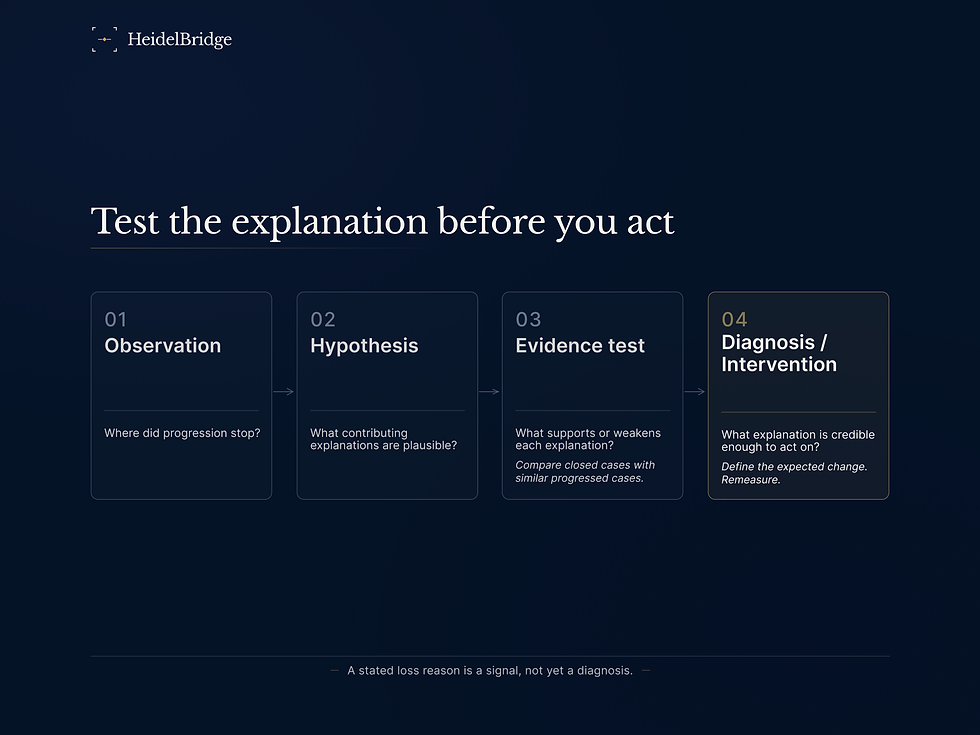
HeidelBridge method: Move from observation to hypothesis, evidence testing, diagnosis and remeasurement.
Consider one worked example.
Observation
Relevant German implant enquiries are entering the journey.
Fit appears healthy.
A disproportionate share of closed cases stops after the treatment plan is sent.
Hypothesis
Several explanations remain plausible:
• treatment inclusions are not clear enough
• total cost is harder to understand than expected
• treatment uncertainty remains unresolved
• travel or aftercare concerns appear late
• timing or decision readiness is unsuitable
Evidence test
The clinic defines the sample and the initial hypotheses before reviewing the case evidence.
Among comparable cases, closed patients ask about treatment inclusions more often than patients who later book.
Coordinator notes show the same questions recurring.
Patient messages confirm that some patients are uncertain about what the plan includes.
Now ask what would weaken the hypothesis.
For example:
• progressed cases show the same clarification pattern
• patients explicitly cite unrelated timing or medical reasons
• no meaningful difference appears between the two groups
Diagnosis
The evidence makes one explanation more credible:
Scope clarity appears to be one contributing factor in non progression after plan delivery for this pathway.
Here, Diagnosis means the most credible operational explanation supported by the available evidence.
It does not mean certainty about a patient’s private motivation.
Intervention
The clinic tests one bounded change, such as clarifying treatment inclusions earlier and more consistently.
Keep the test narrow enough that the resulting evidence remains interpretable.
Before making the change, define what should happen if the explanation is correct.
For example:
• fewer repeated clarification questions
• fewer cases closing immediately after plan delivery
• more recorded decisions after plan delivery
Also define what result would justify continuing, revising or stopping the intervention.
Then remeasure.
If the expected pattern changes, confidence in the explanation may strengthen.
If nothing meaningful changes, reconsider the hypothesis or the intervention.
The intervention therefore creates new evidence.
Use direct patient feedback carefully
Voluntary patient feedback can be useful when it clarifies an otherwise Unknown outcome.
But the purpose is learning, not pressure.
A short closing question should be proportionate, optional and separate from any attempt to persuade the patient to reconsider treatment.
Patient communications used for analysis should follow the same privacy, access and data minimisation discipline as the clinic’s wider measurement system.
Decide whether the pattern deserves action
A repeated pattern deserves intervention only when it is credible and important enough to matter.
Ask:
Frequency
Does the pattern recur?
Evidence
Is the explanation reasonably supported?
Materiality
Does it meaningfully affect the outcome?
Modifiability
Can the clinic influence it enough that a change is worth testing?
Also decide what evidence would be sufficient to deprioritise the hypothesis.
A team should not pursue an attractive explanation indefinitely when new evidence repeatedly weakens it.
A recurring outcome is not necessarily a clinic caused problem.
Repeated preference for local treatment, for example, may reflect a structural market disadvantage rather than weak coordinator communication.
The right response could be a market decision rather than a patient journey intervention.
The decision rule
Take a comparable set of closed cases from the same stage and ask:
Can we distinguish what the patient actually stated from what the team inferred?
Then ask:
Can we point to evidence that would make our preferred explanation wrong?
If not, the non progression evidence is not yet diagnostic.
Start with the stopping point.
Separate outcome from explanation.
Use a reproducible sample.
Define plausible hypotheses before reviewing the evidence, but allow unexpected evidence to emerge.
Triangulate recorded outcomes, behaviour and qualitative evidence.
Compare with similar cases that progressed.
Allow more than one contributing factor.
Look actively for evidence that weakens the hypothesis.
Then use:
Observation → Hypothesis → Diagnosis → Intervention.
Keep the intervention bounded, define what should change if the explanation is right, decide what would make you continue, revise or stop, and remeasure afterward.
Sometimes the correct conclusion will still be:
There is no meaningful, repeated and modifiable issue here that deserves intervention.
The objective is not to psychoanalyse patients.
It is to turn non progression into evidence that can support a more credible management decision.
Sources
1. Decision-making regarding dental treatments - What factors matter from patients’ perspective? A systematic review: https://pubmed.ncbi.nlm.nih.gov/41286802/
2. Patient trust in dentistry: a qualitative study: https://pubmed.ncbi.nlm.nih.gov/40855605/
3. Willingness to pay for dental care: a systematic review: https://pubmed.ncbi.nlm.nih.gov/39948578/
Turn repeated non-progression into hypotheses your team can test against evidence.


